
March 2026 New Home Sales: Spring Acceleration, Structural Pressures Persist
Reflecting the most recent U.S. Census Bureau and HUD release (March 2026) | Published May 2026
March 2026 new home sales rebounded from January’s subdued pace and posted the strongest month-over-month improvement of the early 2026 cycle.
Sales of new single-family homes reached a seasonally adjusted annual rate of 682,000, up 7.4% from February’s revised 635,000 and 3.3% above the March 2025 pace of 660,000. On an actual, not seasonally adjusted basis, 64,000 new homes were sold in March, up from 54,000 in February and slightly above the 63,000 recorded in March 2025.
The improvement was real. So were the structural conditions underneath it: median prices declined meaningfully year-over-year, inventory remained elevated, and months’ supply, while improving, stayed well above balanced market norms. Builders generated transactions through pricing and incentive mechanics, not broad demand recovery.
For prior context, see our January 2026 Home Sales analysis and the broader Home Sales archive.
March 2026 New Home Sales at a Glance
| Metric | March 2026 | February 2026 | MoM Change |
|---|---|---|---|
| SAAR | 682,000 | 635,000 | +7.4% |
| Homes Sold (NSA) | 64,000 | 54,000 | +18.5% |
| Homes For Sale (SA) | 481,000 | 483,000 | -0.4% |
| Median Sales Price | $387,400 | $409,000 | -5.3% |
| Months’ Supply | 8.5 | 9.1 | -6.6% |
Why it mattered:
Volume recovered sharply from January’s multi-month low, and supply conditions improved. But median prices fell both month-over-month and year-over-year, signaling that the recovery was driven primarily by affordability adjustments rather than strengthening unassisted demand.
February and March in Sequence
Note: The U.S. Census Bureau did not release a standalone February 2026 new residential sales report. Initial February estimates were published for the first time as part of the March release on May 05, 2026. As a result, Dark Sky Data does not publish a separate February analysis; February figures are covered here as context for the March data.
The Census Bureau’s March release provides the initial February estimate alongside March results, creating a clearer two-month sequential picture.
February 2026 came in at 635,000 SAAR, an 8.9% increase from January’s revised 583,000. March extended that trajectory with a further 7.4% gain.
The back-to-back improvement from January through March reflects a meaningful recovery from the year’s weakest point. January 2026 at 583,000 SAAR was the softest reading of the trailing 12-month period. February and March both accelerated from there.
The question is whether that acceleration represents genuine demand recovery or affordability-driven responsiveness. Pricing behavior in March points clearly toward the latter.
March 2026 New Home Sales: Actual Transactions (Not Seasonally Adjusted)
Monthly Closings — NSA
| Month | Homes Sold (NSA) | Notes |
|---|---|---|
| January 2026 | 48,000 | Revised |
| February 2026 | 54,000 | Preliminary |
| March 2026 | 64,000 | Preliminary |
| March 2025 | 63,000 | Year-ago comparison |
Actual March 2026 closings of 64,000 came in essentially in line with March 2025’s 63,000, suggesting monthly transaction flow stabilized in March even as Q1 cumulative volume remained below 2025 levels.
Year-to-date through March 2026, 166,000 new homes have been sold on a not seasonally adjusted basis, compared to 175,000 through the same period in 2025, a 5.0% decline. Q1 2026 ran below 2025 levels in absolute terms even as March itself slightly exceeded its year-ago reading.
Regional Breakdown — New Residential Sales (NSA, March 2026)
| Region | March 2026 Homes Sold |
|---|---|
| South | 41,000 |
| West | 13,000 |
| Midwest | 7,000 |
| Northeast | 3,000 |
The South remained the dominant volume driver, accounting for approximately 64% of all new home transactions in March. Both the South and West showed sequential improvement from February. The Northeast recorded its lowest NSA monthly volume of the early 2026 cycle.
New Construction Structural Metrics
Inventory compressed modestly in March, and months’ supply improved meaningfully, though it remains elevated relative to historical equilibrium.
Inventory and Supply — Seasonally Adjusted
| Metric | January 2026 | February 2026 | March 2026 |
|---|---|---|---|
| Homes For Sale (SA) | 477,000 | 483,000 | 481,000 |
| Months’ Supply | 9.8 | 9.1 | 8.5 |
Months’ supply at 8.5 represents a meaningful improvement from January’s 9.8, the highest reading of the recent cycle. The compression reflects both increased sales volume and slightly lower inventory. However, 8.5 months remains materially above the 6.0 threshold typically associated with market equilibrium.
On a year-over-year basis, homes for sale declined 4.6% from March 2025’s 504,000, while months’ supply improved from 9.2 to 8.5. That improvement reflects gradual absorption rather than a broad demand surge.
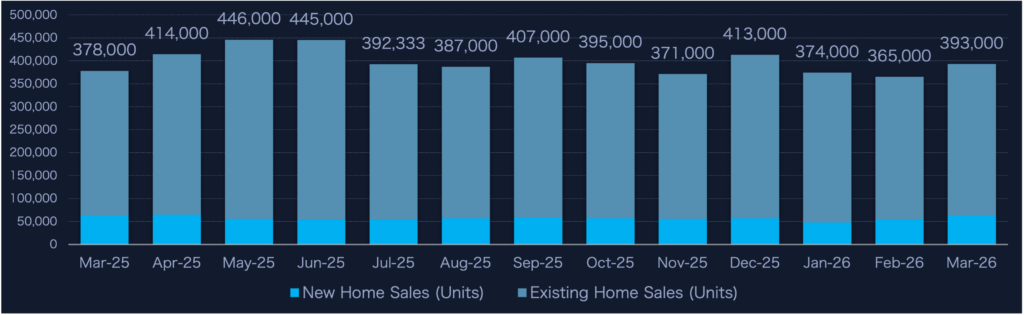
Existing Home Sales: Resale Liquidity Remains Constrained
While builders generated incremental transaction flow through incentives and pricing flexibility, the resale market remained structurally constrained in March 2026.
Existing home sales continued operating under elevated mortgage-rate lock-in conditions, limiting available inventory even as affordability pressure weighed on buyer activity. Homeowners carrying sub-4% mortgage rates remained reluctant to transact into materially higher financing costs.
That dynamic continues creating a bifurcated market structure. Builders can manufacture affordability through incentives, rate buydowns, and spec inventory. Existing homeowners generally cannot.
The result is selective liquidity. Transaction flow is occurring where financing flexibility exists, while portions of the resale market remain constrained by rate-sensitive seller behavior.
For warranty marketers, administrators, and housing-adjacent financial stakeholders, that distinction matters. Builders continue capturing an outsized share of marginal housing activity because they retain pricing flexibility that resale inventory does not.
Stage of Construction: Completed Homes Lead the Market
Homes Sold by Stage — NSA, March 2026
| Stage | Units Sold |
|---|---|
| Not Started | 5,000 |
| Under Construction | 23,000 |
| Completed | 36,000 |
Of the 64,000 homes sold in March, 36,000 were completed, meaning buyers are primarily transacting on finished inventory rather than pre-construction units. This pattern reflects continued builder incentive activity tied to ready-to-occupy homes where rate concessions and price adjustments can be deployed immediately at closing.
The median number of months completed homes have been on the sales market reached 3.6 in March 2026, up from 3.3 in February and 2.8 in March 2025. Completed inventory is sitting longer than it did a year ago.
Sales Price: Volume Improved, Pricing Did Not
The median sales price of new homes sold in March 2026 was $387,400, down 5.3% from February’s $409,000 and down 6.2% from March 2025’s $412,900.
The average sales price was $503,100, down 3.4% from February and 1.2% below March 2025.
Price reductions of this magnitude alongside volume gains were not coincidental. Builders generated March transactions through affordability mechanisms: incentives, rate buydowns, and price adjustments that lowered effective payment barriers.
Price Distribution — NSA, March 2026
| Price Range | Units Sold | Share of Total |
|---|---|---|
| Under $300,000 | 13,000 | 20% |
| $300,000 – $399,999 | 22,000 | 34% |
| $400,000 – $499,999 | 12,000 | 19% |
| $500,000 – $599,999 | 6,000 | 9% |
| $600,000 – $799,999 | 6,000 | 9% |
| $800,000 – $999,999 | 2,000 | 3% |
| $1,000,000 and over | 4,000 | 7% |
The $300,000–$399,999 bracket accounted for 34% of all March transactions, the largest single price tier. Combined with homes under $300,000, the sub-$400,000 segment represented 54% of total volume.
Buyers concentrated in the most affordable tier available, reinforcing the affordability-first pattern that has defined March 2026 new home sales and the broader early-2026 cycle.
Regional Trends: Year-to-Date Context
| Region | YTD Volume Change (2026 vs. 2025) | Notes |
|---|---|---|
| South | -2.6% | Highest absolute volume; incentive-driven activity |
| West | -14.0% | Affordability constraints most acute |
| Midwest | +8.0% | Only region with YTD volume growth |
| Northeast | -17.6% | Structurally smallest market; steepest relative decline |
The Midwest was the only region to show year-to-date volume growth through March 2026, up 8.0% versus the same period in 2025. The West showed the steepest year-to-date decline at -14.0%, consistent with heightened affordability pressure in higher-cost markets. The South retained the largest overall transaction share despite a modest year-to-date decline.
Regional dispersion remains intact. Markets where inventory has expanded and affordability pressure is highest continue to show the weakest volume trajectories. The Midwest’s relative resilience reflects comparatively lower price points and more stable absorption conditions.
Mortgage Rates and Affordability
Mortgage rates remained elevated throughout Q1 2026 relative to the ultra-low financing environment that defined much of the prior cycle. That pressure continues shaping both buyer behavior and transaction composition.
In the new-home market, builders responded with pricing flexibility and financing incentives. In the resale market, many homeowners simply stayed put.
Affordability constraints therefore continue influencing not only transaction volume, but where transactions occur. Inventory alone does not guarantee absorption. Payment structure remains the primary gating factor for housing activity.
That distinction is increasingly important for housing-adjacent businesses relying on transaction flow assumptions built during materially different financing conditions.
Market Implications Heading Into Q2 2026
March 2026 new home sales confirmed that builder-driven volume can recover quickly when pricing is adjusted. They did not confirm that underlying demand is strengthening independently of affordability concessions.
The sequential improvement from January through March is meaningful context. Months’ supply compressed from 9.8 to 8.5. Actual closings matched year-ago levels. The South and Midwest held up relatively well.
But median prices declining 6.2% year-over-year while Q1 2026 closings remained 5.0% below 2025 levels indicates a market where activity is being manufactured through pricing flexibility, not demand-driven absorption.
Builders remain the most adaptable liquidity mechanism in the housing market. That adaptability has a cost, and March made the cost visible.
For broader historical perspective, explore Dark Sky Data’s prior housing transaction analysis in the Home Sales archive.
Channel Playbooks
IF YOU MARKET DIRECT-TO-CONSUMER (DTC)
- Target markets and price tiers where builder-driven volume is recovering, particularly sub-$400,000 completions in the South and Midwest
- Align messaging with affordability and payment predictability
- Avoid appreciation-driven positioning; buyers in March 2026 were payment-sensitive, not equity-motivated
Volume is recovering where pricing is engineered. Messaging should follow the same logic.
IF YOU WORK WITH REAL ESTATE AGENTS
- The Midwest’s year-to-date outperformance makes it the most defensible region for stable transaction flow
- Position warranties as closing-completion tools in markets where completed inventory is sitting longer
- Support agents with pricing-discipline and days-on-market messaging as affordability constraints extend transaction timelines
Conversion efficiency matters more than broad volume assumptions in a market where buyer activity concentrates in specific price tiers.
IF YOU PARTNER WITH BUILDERS
- Align with the sub-$400,000 completion segment where volume is most active
- Bundle warranties with financing incentives and rate buydown packages at closing
- Focus on communities where incentive activity is already generating closings; completed inventory sitting at 3.6 median months on market represents active opportunity
Builders generated March’s volume through affordability engineering. Warranty integration fits the same positioning.
Data Revision Disclosure
Housing market statistics are frequently revised as additional survey responses are collected and seasonal adjustment models are updated. The U.S. Census Bureau and the U.S. Department of Housing and Urban Development routinely revise prior-month data, including sales volume, inventory levels, and pricing metrics. As a result, figures cited in this analysis may differ from those reported in prior monthly releases.
Unless otherwise noted, this analysis reflects the most current data available at the time of publication.
Data Sources
This analysis draws on March 2026 data from:
- U.S. Census Bureau — New Residential Sales (Release CB26-66, May 05, 2026)
- U.S. Department of Housing and Urban Development
- Federal Reserve Economic Data (FRED)
About Dark Sky Data
Dark Sky Data provides housing, economic, and property intelligence designed to help home warranty providers, administrators, and real estate professionals anticipate demand, segment markets accurately, and allocate resources with confidence.
National headlines blend markets. We isolate them.